
Something important happened back in June that received far less attention than it deserved.
After a lengthy silence on the topic, Donald Trump started posting on Truth Social again about Canada becoming the 51st State. He did that in response to news of Canada being in a ‘technical’ recession. While many continue to brush his taunts off as joking, or bluster, they are neither of those things. But they are reflective of a pattern.
On May 31 – just one day before Trump’s Truth Social post – Canadian Conservative leader Pierre Poilievre declared that Canada was in a recession, demanding an emergency debate with Prime Minister Mark Carney in the house of commons.
The President of the United States responded immediately by using Canada’s economic vulnerability as a fresh argument for annexation. In the same week that his administration, with Canadian tariffs firmly in place, has CUSMA renegotiations restarting.
The timing of Poilievre’s exaggerated stance on the economy and Trump’s nefarious post about taking Canada is not a coincidence. It’s a story that deserves sustained and serious journalistic investigation and critique.
Press conferences have replaced news coverage
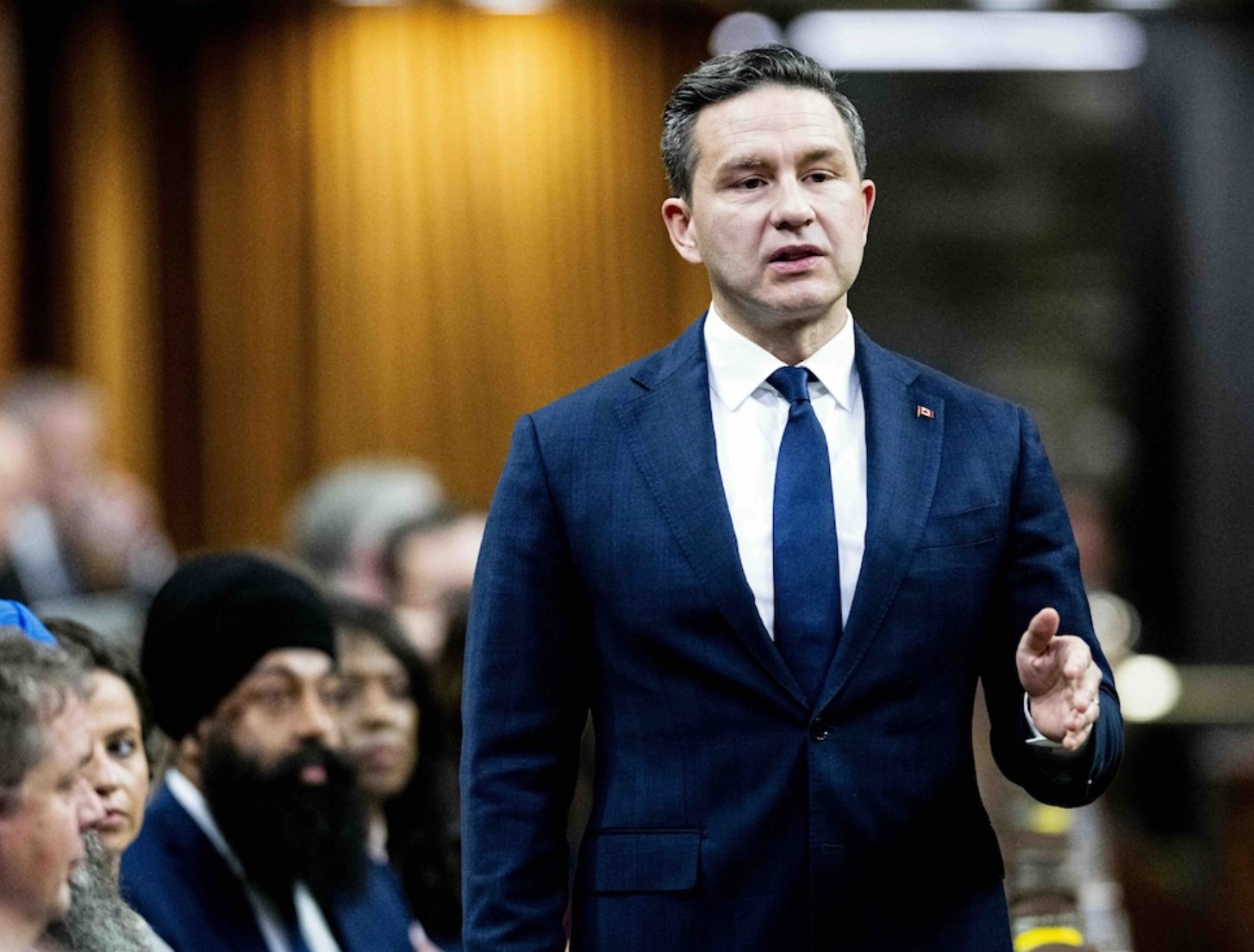
Canadian political coverage has become structurally distorted. It no longer serves the public, nor the democratic institutions that journalism is supposed to hold accountable. Press conferences held by Pierre Poilievre generate livestreaming and wall-to-wall coverage simply because he is the Leader of the Official Opposition. Regardless of whether they contain any verifiable news.
Every time he takes to the podium, his statements are broadcast in real-time, fully and completely. Complete with demands, accusations, and blame directed squarely at Prime Minister Mark Carney and the Liberal party.
His words are aired, transcribed, headlined, and distributed to millions of Canadians, as if their utterance alone constitutes a newsworthy event. The critical question of whether what being said is actually true is now treated as secondary to what is sufficiently quotable. And this matters.
Poilievre has a documented and sustained pattern of making claims that do not hold up to scrutiny. Yet, his exact claims are being amplified in a media environment that either lacks resources, or the institutional will to interrogate them before reporting.
Spreader of false information
Poilievre’s record is worth examining. He called Canada’s 0.1 percent GDP contraction a ‘Liberal recession’. When four major bank economists, the Bank of Canada, and the Canadian Federation of Independent Business attributed it primarily to American tariff pressure and external economic shocks. Rather than to domestic policy failure.
He repeated the claim that Prime Minister Carney refuses to pay his taxes in Canada. This statement is contradicted by documented fact that Prime Minister Carney is a Canadian resident who files and pays Canadian taxes. Whose assets are in a blind trust independently controlled and approved by the federal Ethics Commissioner.
Poilievre continued to describe Brookfield as Prime Minister Carney’s company – when the company was never owned by Mark Carney. Meanwhile, Poilievre’s own financial disclosures confirm he holds investments in a Vanguard ETF whose top holdings include both Brookfield Asset Management and Brookfield Corporation.
Pierre Poilievre stated on Joe Rogan’s podcast that Canada admits one million immigrants per year, a figure that no government data supports. He falsely characterised a sentencing outcome in the Holocaust monument vandalism case. Claiming no real jail time was served when the offender had in fact spent months in custody at the Ottawa-Carleton Detention Centre before pleading guilty and released on strict bail terms.
Each of these claims was repeated, amplified, and largely left unchallenged in coverage. Which frames them as legitimate political discourse rather than demonstrably false statements made by the Leader of the Official Opposition to a national audience.
Playing the blame game
At the Conservative convention in January 2026, Poilievre blamed Liberal policies for fuelling separatist movements in both Alberta and Quebec. He argued that Ottawa had been stomping on Alberta’s energy sector and Quebec’s jurisdiction.
When Alberta’s separatist movement gained momentum in February, Poilievre told the Globe and Mail’s editorial board that the first job of Prime Minister is to keep the country united. It’s a standard he applied exclusively to Prime Minister Carney. While his own political network’s connections to the separatist movement have never been formally addressed.
For example, Take Back Alberta is the organisation that claims credit for Danielle Smith’s election. Co-founder David Parker was central to the illegal Centurion Project voter data operation. He has campaigned for Pierre Poilievre, and the two have posed happily for photos together.
Poilievre vows to fight for a united Canada while sharing a conference stage in Ottawa with Pete Hoekstra. The American Ambassador who repeatedly suggests Canada should become the 51st state. And Mike Pompeo, the former Secretary of State who architected the America First framework that treats Canadian interests as subordinate to American ones.
Poilievre’s unity call is contradicted by his sustained rhetorical strategy of framing every domestic policy debate as a fight between ordinary Canadians and liberal elites. This framework is explicitly borrowed from the populist playbook, designed to fuel division in every jurisdiction where it is deployed.
Intentional in the messaging
The consequences of Pierre Poilievre’s words are not simply theoretical. When Donald Trump posted about the ’51st State’ back in June, he used as justification the same Liberal recession framing that Poilievre had just fed to Canadian and American media.
Think about it for a moment. The Leader of Canada’s Official Opposition puts out a specific economic narrative. That is picked up, amplified, carried across the border, and deployed by a foreign head of state. As an argument for annexing Canada – the leader’s own country.
This is evidence of how treating Poilievre’s claims as news without interrogating their accuracy comes with consequences. Misinformation about Canada’s economy was produced domestically, travelled internationally, and returned as a threat to Canadian sovereignty. That chain of events deserves to be stated plainly and connected explicitly in coverage that understands what is at stake.
Canadian media is working against the standard of journalistic accountability this moment demands. Rather than prioritizing facts, they now chase traffic metrics that are fueled by conflict and outrage.
The absence of investigative journalism
The 24-hour news cycle needs content, and live-streaming press conferences is cheap compared to actual investigative reporting. Politicians willing to say sharp and quotable things on camera every day is content that requires almost no editorial resources to deploy. Regardless of whether what he is saying is true or not.
A media environment that produces story after story built around what Poilievre says, demands, wants, accuses, blames, calls for, and challenges, without systematically asking whether those statements are accurate, is not serving Canadian democracy. What it’s doing is laundering political messaging as news, and spreading propaganda that is feeding a larger machine.
Canadians trying to understand our country and economy during one of the most consequential periods in our history deserve better than that. Our sovereignty is being challenged by a foreign president who uses domestic disinformation against us.
Fed to him by Pierre Poilievre.
Annie Koshy is a Canadian independent journalist, branding specialist, and multimedia artist. Her work focuses on branding, media literacy, geopolitics, and narrative framing. She writes and produces cross-platform analysis examining how power, language, and institutions shape public understanding. Find her at Substack.
Writer’s Note: This article is an analysis of political rhetoric, institutional norms, and democratic process. It examines publicly available statements, actions, and political framing to assess their alignment with established governance structures and broader ideological trends. The intent is not partisan advocacy, but scrutiny of how power, mandate, and political performance intersect in Canada’s current political landscape.
Sources for reference
Yahoo News, Trump Renews Attacks on 51st State Canada, June 2, 2026
https://www.yahoo.com/news/politics/articles/trump-renews-attacks-51st-state-041424760.html
The Conversation, Fact check: Pierre Poilievre’s misinformation on Joe Rogan’s podcast disrespects Canadians, March 24, 2026
https://theconversation.com/fact-check-pierre-poilievres-misinformation-on-joe-rogans-podcast-disrespects-canadians-278864
Canadian Lawyer, Poilievre’s lies about my client illustrate a wider problem with grievance politics, January 23, 2026
https://www.canadianlawyermag.com/news/opinion/poilievres-lies-about-my-client-illustrate-a-wider-problem-with-grievance-politics/393624
CBC News, Poilievre says Conservatives want national unity in face of separation threats, February 17, 2026
https://www.cbc.ca/news/canada/calgary/poilievre-national-unity-separatism-9.7094748
Globe and Mail, Poilievre vows to make the case for unity to Albertans, May 2026
https://www.theglobeandmail.com/politics/article-pierre-poilievre-unity-to-alberta-separatism-conservative-leader/
BNN Bloomberg, Canada GDP Q1 2026, May 29, 2026
https://www.bnnbloomberg.ca/business/economics/2026/05/29/canada-slips-into-technical-recession-as-economy-stalls-in-q1-statcan/
Global News, Poilievre calls for emergency debate as Canada enters technical recession, June 1, 2026
https://globalnews.ca/news/11875527/technical-recession-poilievre-emergency-debate