
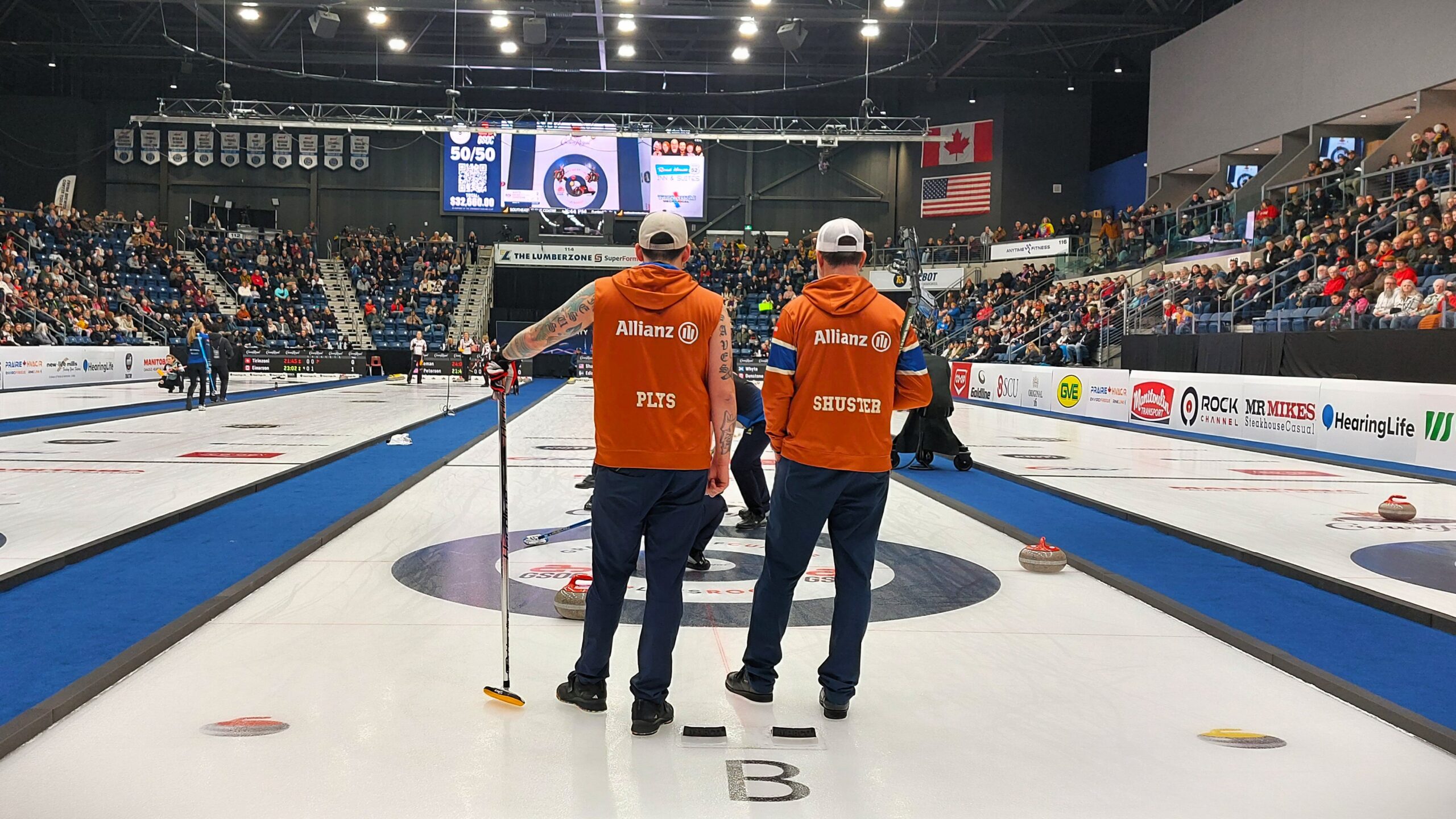
If you’ve stumbled onto a broadcast of Olympic curling, you’re not alone. And if you find it strangely fascinating, yet aren’t quite sure what’s happening… you’ve come to the right place.
Each time the Winter Olympic Games roll around, curling slides into the public psyche once again. Appearing like a cross between shuffleboard and chess. With 44-pound granite rocks being thrown back and forth down a long narrow sheet of ice. Hushed conversations, intense staring, high fives, and sudden vocal outbursts are common. Words like ‘woah’, ‘hurry’, ‘hard’, and ‘hurry hard’ are imperative. The louder spoken, the more critical the situation.
To those new to the sport, there’s more to curling than you might think. While it looks deceptively simple, it isn’t. Not by a long shot.
Skills and strategies
Curing requires a range of dynamic skills, delivered with precision, finesse, grace, and grit. Combined with a whole lot of strategy. It involves two teams of four players competing, delivering 16 stones (aka rocks) from one end of the ice to the other in a bid to win points.
Each player throws two curling stones, making a total of eight for each team, all the same colour. Players alternate throwing from a rubber foothold called the ‘hack’ towards the distant house. After all rocks are thrown, that ‘end’ is complete.
Think of an ‘end’ as a measure of play, like an inning in baseball. A baseball game consists of nine innings. In professional curling, a game consists of ten ends. And each end, only one team can score. Whoever has the most points after ten ends wins the game. If the score is tied after ten, one extra end is played.
Closest to the button
A set of coloured rings is painted into the ice at each end. These are called the 12-foot ring (being 12-feet across), the 8-foot, the 4-foot, and the button. Together these rings are known as the ‘house’.
After all 16 rocks are thrown, the team that scores is the one closest to the button. If one stone is closer than the opponent, that’s one point scored. Two stones are closer, that’s two points. Three stones, three points. Etc. Each team tries to place and defend their rocks to score points, while stopping their opponents from trying to do the very same thing.
Only one team scores in each end. Except when nobody scores. This happens when the house is ‘blanked’ – meaning that all stones are intentionally removed from the rings. There are reasons for blanking an end, and they revolve another tool from the gameplay toolkit.
Hammer time
As logic would suggest, being able to throw the last stone in any end would give an advantage. Having this advantage is called the ‘hammer’. Whichever team throws last end, is the team with the hammer. You’ll hear this word often in curling commentary.
The hammer provides a scoring edge because it allows the team who has it to control the final shot. It alternates back and forth during the game, depending on who scores. Whichever team doesn’t score in an end… they are given an advantage in the next end by having the hammer. By throwing last rock.
Anytime a team has the hammer, their aim is to score at least two points. If they can’t, they’ll sometimes avoid having to take a single point by ‘blanking’ the end. Provided it’s still possible to eliminate every rock from the house. When nobody scores in an end, the hammer carries over to the same team for the next end.
When one team has the hammer, but the other team succeeds at getting their rock closest to the button… that’s called a ‘steal’. Because they essentially stole the hammer advantage.
The role of each player
Each of the four players have a specific role on a curling team. The skip is the on-ice strategist who plans the rock placements, calls for the shots, and usually throws the last two stones. It’s a position part quarterback, part pool shark, and part walking a tightrope. The skip has to have a sharp mind, effective strategy, the skill to pull off any shot, and nerves of steel.
The skip spends most of their time in the house at the opposite end of the ice. They hold the broom down for players to aim at, and request a certain kind of ‘weight’ – how light or heavy to throw the stone.
With the skip in place in the house… throwing the first two stones is the lead. Most times, these stones will be set up as ‘guards’ for other rocks to hide behind, or to block opponents from getting their rocks closest to the button.
Next up is the second player, called the second. They throw two rocks with a broader arsenal of shots – like draws, tap-backs, and take-outs. Then the third throws their two rocks, with shots getting even trickier still.
When it’s the skip’s turn to throw the final two rocks in an end, the third takes over the house to hold the broom.
Other elements of the game
The ‘hog line’ is the thick painted line that across the ice that the players slide towards when they push out of the hack. Stones must be released before they reach the hog line, or else they are pulled from play. As the rock slides, it must fully cross over the opposite hog line in order to stay in play. It if doesn’t cross, it is also pulled.
‘Sweeping’ or ‘brushing’ is when two players follow alongside the rock. Sliding brooms/brushes back and forth in front of the rock to affect the play. Sweeping warms the ice to reduce friction, allowing the stone to travel farther and stay straighter. It can also help a rock to ‘curl’ more in one direction over the other.
If you read this far, hopefully you’ll know a little more about curling now. So the next time you watch it, it’ll make a lot more sense. It will be a lot more enjoyable to know the gameplay. And to understand what all the ‘hurrying hard’ is about.