The Long Walk was published under Stephen King’s pseudonym ‘Richard Bachman’ in 1979, and made into a movie in Manitoba in 2024. The plot focuses on a dystopian America, where teenaged boys are selected by lottery to represent their country in an annual competition.
The Long Walk was adapted for film by screenwriter JT Mollner, with Francis Lawrence directing. A master at films set in dystopian societies, Lawrence’s credits list The Hunger Games: Catching Fire, The Hunger Games: Mockingjay – Part 1, and The Hunger Games: Mockingjay – Part 2.
When King wrote The Long Walk in the late 1960s, the Vietnam War was being fought. While the time period of the story is intentionally ambiguous, one might assume it is set around the same era – but in an altered world. A different America. One that had become a more fascist state.
The Long Walk can be described as a dichotomy between brotherhood and brutality, with participants having to walk without rest while maintaining a minimum speed. The compelling story has a complex mix of characters, with each having to endure the horrors in their own way.
The stand-out ensemble cast is led by Cooper Hoffman (Ray Garraty), David Jonsson (Peter McVries), Garrett Wareing (Stebbins), Tut Nyuot (Arthur Baker), Charlie Plummer (Gary Barkovitch), Ben Wang (Hank Olson), Jordan Gonzalez (Richard Harkness), Joshua Odjick (Collie Parker), and Roman Griffin Davis (Curly). Rounding out the cast are Judy Greer as Mrs. Garraty, and the legendary Mark Hamill in the role of The Major.
Making a movie in motion
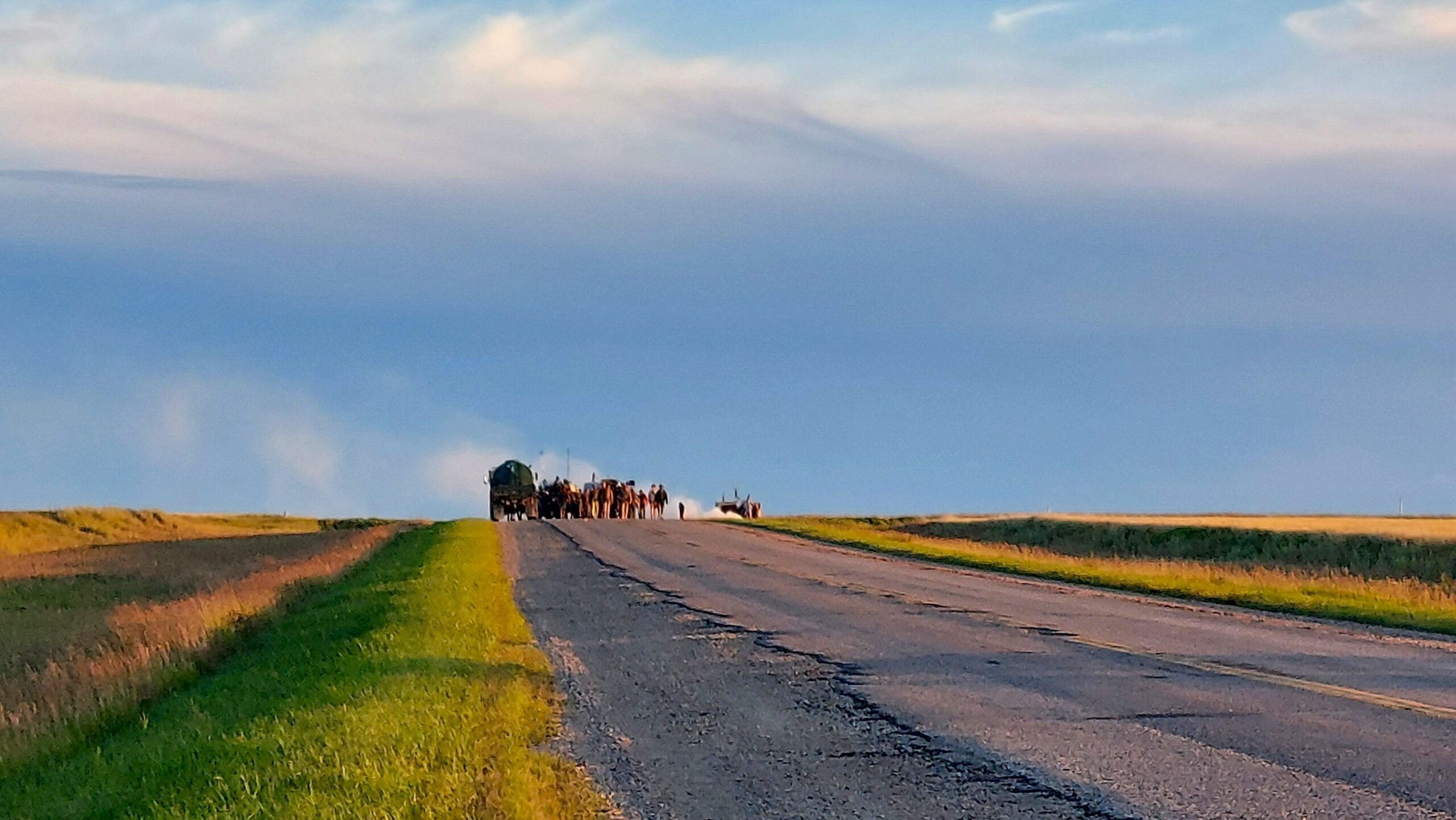
Principal photography for The Long Walk took place in Canada during the summer of 2024. Scenes were captured in rural locations throughout the province of Manitoba, and within the City of Winnipeg.
Not only would the film be emotionally and physically tough to shoot, but would also be logistically challenging. There was a collective sense among cast and crew that a film like this had never been done before. Where the actors never stop walking. With filmmaking tasks having to be done on the move. It seemed like a revolutionary approach to filmmaking.
The unit had to be fully portable, with camera carts, mobile video villages, follow vans, cast cars, and crew shuttles. This allowed the production team to move with the walkers, capturing the scenes playing out. Much of the crew walked the same distances as the actors during multiple takes of each scene. Francis Lawrence also walked back with the cast to their first positions after each cut. Every single time.
Unique order of scenes
Something else not common to filmmaking is shooting a movie in sequence. But to present the story in the most believable way, The Long Walk was shot from start to finish. As filming progressed, this allowed the actors – who were constantly walking – to naturally become more tired, and more rundown. Progressing from eager fresh-faced boys setting out on an adventure, into the horrific realization of the dark journey they are on.
In the story, each of the walkers was able to bring along a bag to carry personal items in. In real life, each of the actors were allowed to choose their own props to put in the bags. To choose for themselves what their characters might have actually brought along. The same approach was taken with wardrobe, with each actor able to select their own clothes and footwear for the journey.
Going the distance for each other
Every day the actors filmed their scenes in actual conditions, rain or shine, or whatever else was in the cards. Early in the shoot, the weather sometimes reached a stifling 100-degrees in the afternoons, with heatstroke top of mind. Later in the schedule, on the night shoots, it dropped down to near 32-degrees. No matter which extreme it was, the actors often went home at the end of the day with ‘shivers’.
One of the cast tracked all of the distance walked, and by the final week of filming had already clocked 251 miles, or 400 kilometers. With several scenes left to go.
There was a natural sense of camaraderie that progressed throughout filming. The grueling days and the physicality of the walking resulted in the cast growing closer together, and genuinely caring about each other’s well-being day-by-day. As a result, this gave the film an added layer of heart and humanity.
Canadian province shines in The Long Walk
Locations were ‘locked down’ for days at a time to accommodate the distances physically covered. Ever-changing landscapes feature country roads, farmer’s fields, rolling hills, steel bridges, cemeteries, abandoned villages, and gritty cityscapes. All seamlessly flowing one to the next.
Specifics seen on screen were a small country church, an abandoned gas station, and an old beat up diner. The art department also created their own cemetery outside one of the towns.
At least two of the Manitoba locations were ‘discovered’ on the fly. These include Seven Sisters Generation Station in the Whiteshell region, and the Arlington Bridge in the centre of Winnipeg. Both of these locations had story points adapted so they could be used in filming.
Filming occurred either right in town or nearby the Manitoba towns of La Riviere, Saint-Lazare, Marquette, Warren, Argyle, Stonewall, and Garson. Birds Hill Provincial Park with its close proximity to Winnipeg was also in play for the entire first week of filming.
Significant scenes were shot in the city’s historic Exchange District – one of the most iconic neighbourhoods in Winnipeg. It’s exceptional collection of heritage buildings built between 1880 and 1920 became the backdrop for the movie. In particular, the film’s finale.
If you want to know the ending… you’ll have to see the movie for yourself. The only thing I will say is that The Long Walk will hit you in ways you don’t expect. And that’s something you can be sure of.