
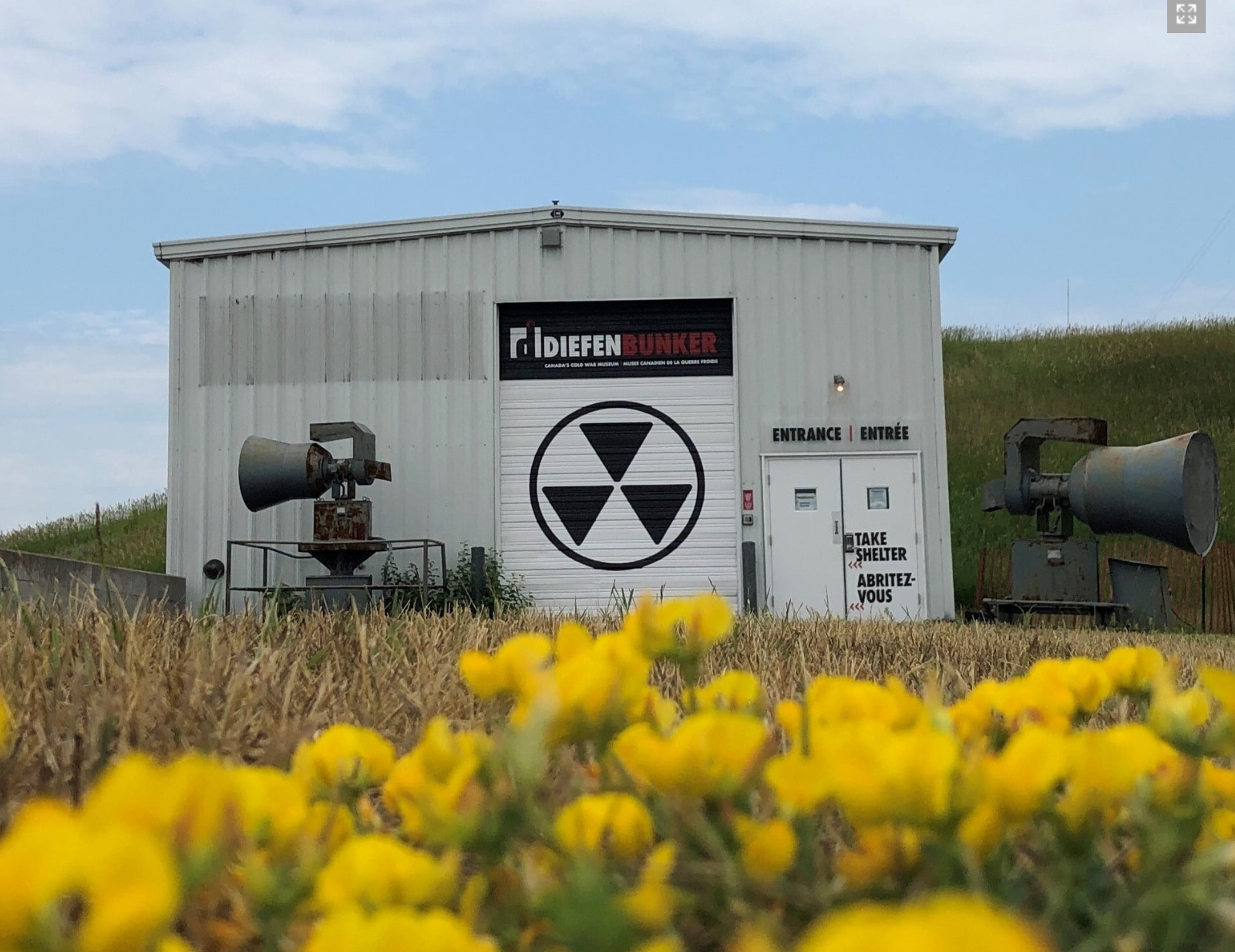
Winding your way through the countryside just outside of Ottawa can lead to an unexpectedly cool attraction you’ve likely never heard of. Because the Diefenbunker was built to be one of the best-kept secrets in the country.
During the height of the ‘Cold War’ In 1959, tensions were escalating worldwide. In the event of nuclear attack, Prime Minister John Diefenbaker envisioned a safe place for key members of the government and military. He commissioned a top-secret bunker that same year, under code name Project Emergency Army Signals Establishment (EASE).
The site had to be within evacuation distance of downtown Ottawa, in a natural valley, with ideal geological conditions. They chose a farm 35 kilometers away, near the town of Carp. It would house a 23-meter underground bunker designed and engineered in less than 18 months.
An extraordinary ‘ordinary’ shed
From the outside, the Diefenbunker looks like any ‘ordinary’ aluminum-sided shed with garage door. But inside, this extraordinary marvel of engineering spans 30,480 square meters over four levels, made with 5000 tons of steel, and 32,000 cubic yards of hand-poured concrete.
A gigantic steel culvert is the main attraction, built to withstand a 5-megaton strike from 1.8 kilometers away. The 118-meter ‘Blast Tunnel’ would allow the pressure wave from a nuclear blast to be diverted away from the main hub. Ensuring the bunker itself remained safe.
From 1961 until 1994, the site was functional. It remained in continuous operation until finally facing decommission. At all times during operation, the Diefenbunker was prepared to go into deep lockdown. Stocked with enough food to feed 535 people for 30 days. It regularly maintained a staff of 100-150 people on 24-hour shift rotation.
A piece of Canada’s history
The Diefenbunker was given National Historic Site status in 1994, and reopened as a museum in 1997. Today it is Canada’s most significant Cold War site, home to tourists, school programs, corporate events, and catered dinners.
The Diefenbunker offers daily tours that wind through the underground labyrinth, revealing meeting rooms and living quarters. With focal points like the Prime Minister’s suite, the War Cabinet Room, and the Medical Centre. The Bank of Canada Vault available to store gold and other valuables.
Ever-changing exhibits highlight archival documents and artifacts, and the Artist-in-Residence program features connections between the museum, local artists, and wider community.
Modern day uses
A unique location for getting together, the bunker is available for community engagement through special events. ‘Escape the Diefenbunker’ is a popular escape room, where an imminent ‘Red Alert’ attack kicks you into action.
The task is to find the communications centre, transmit the news to the outside world of possible nuclear disaster, and attempt to stop the incoming threat. It’s an escape to save the world that requires bravery, brawn and brains.
It’s also eerily haunting, given the geopolitical times we are living in. When nuclear threat is once again real, and no longer just an exhibit at a National Historic Site.