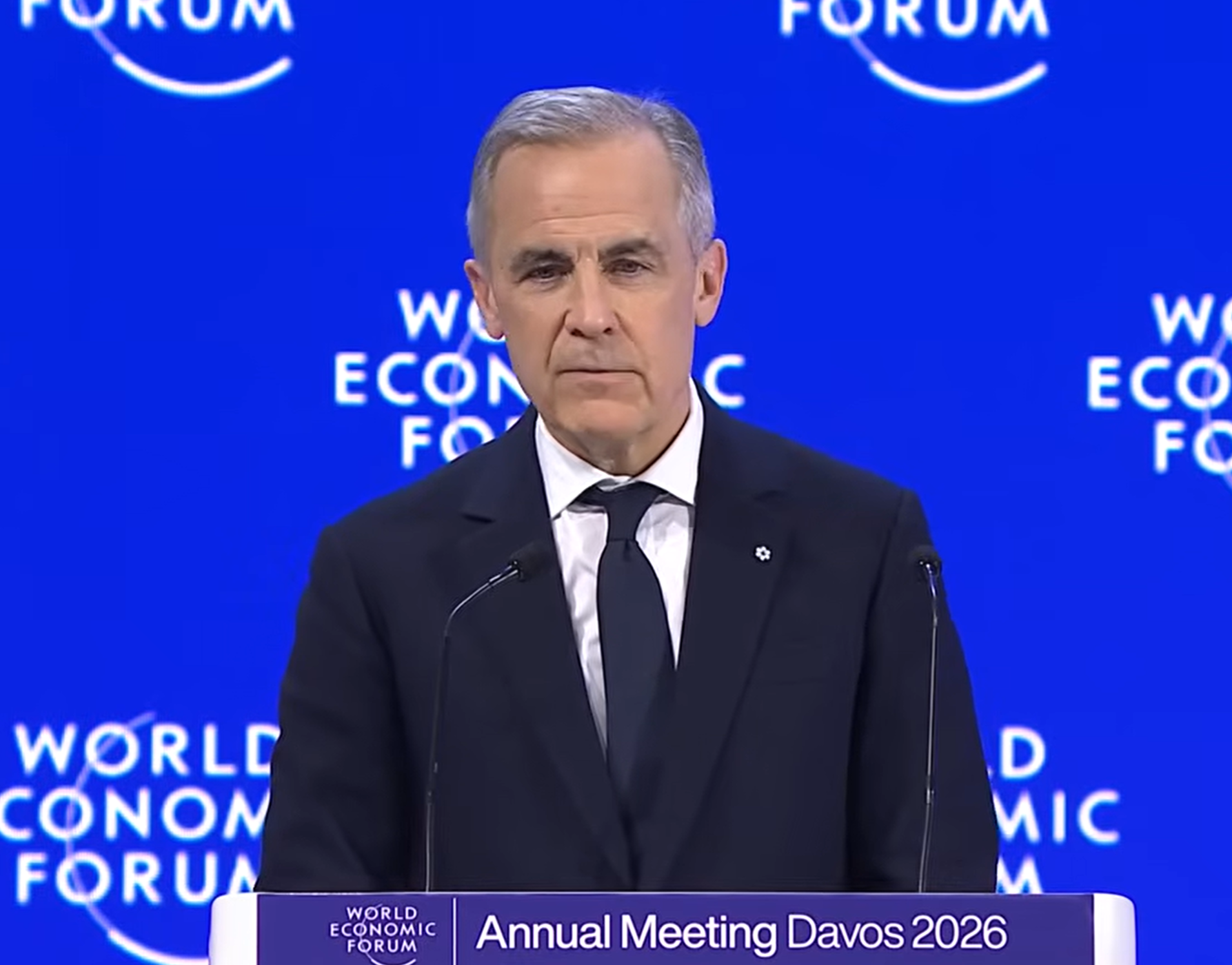
Canada’s Prime Minister Mark Carney captured audiences with his address at the 56th World Economic Forum in Davos, Switzerland.
On January 20, 2026, in a speech he wrote himself, Mr. Carney declared the long-standing “rules-based international order” to be in a state of “rupture.”
He warned that great powers increasingly use economic tools like tariffs, financial infrastructure, and supply chains, as instruments of coercion. He urged “middle powers” like Canada to “forge new alliances.” To protect shared values and stability. To stick together.
International acclaim and respect
Accordingly, Carney’s blunt assessment at the World Economic Forum struck a chord. And earned a rare standing ovation in the Davos Congress Hall. Leaders and commentators worldwide praised his clarity, candour, and courage.
Markedly, Finland’s president called it among the most “impactful speeches” of the forum. While NATO officials said it signalled Canada’s return as a “pivotal international voice.” Others referred to it as the speech of a generation, on a shifting geopolitical landscape.
The man behind the podium
Mark Carney isn’t your ordinary politician. Significantly, he came into national leadership already widely respected as a leading expert in global economics.
He is the only person in history to have served as governor of two G7 central banks. After leading both the Bank of Canada and the Bank of England. This dual role cemented his reputation as one of the world’s most trusted and influential economic policymakers.
Mark Carney was educated at Harvard and Oxford. As well, he played competitive ice hockey throughout university. He has joked that his “goalie mindset” is what has trained him to stay calm under pressure.
Transcript of Mark Carney’s speech
Thank you very much, Larry. I’m going to start in French, and then I’ll switch back to English.
[The following is translated from French] Thank you, Larry. It is both a pleasure, and a duty, to be with you tonight in this pivotal moment that Canada and the world going through.
Today I will talk about a rupture in the world order, the end of a pleasant fiction and the beginning of a harsh reality. Where geopolitics, where the large, main power, geopolitics, is submitted to no limits, no constraints.
On the other hand, I would like to tell you that the other countries, especially intermediate powers like Canada, are not powerless. They have the capacity to build a new order that encompasses our values, such as respect for human rights, sustainable development, solidarity, sovereignty and territorial integrity of the various states.
The power of the less power starts with honesty.
[Switch to speaking English] It seems that every day we’re reminded that we live in an era of great power rivalry. That the rules based order is fading, that the strong can do what they can, and the weak must suffer what they must.
And this aphorism of Thucydides is presented as inevitable, as the natural logic of international relations reasserting itself.
And faced with this logic, there is a strong tendency for countries to go along to get along. To accommodate, to avoid trouble, to hope that compliance will buy safety.
Well, it won’t.
So, what are our options?
In 1978, the Czech dissident Václav Havel, later president, wrote an essay called The Power of the Powerless, and in it, he asked a simple question: how did the communist system sustain itself?
And his answer began with a greengrocer.
Every morning, this shopkeeper places a sign in his window: ‘Workers of the world unite’. He doesn’t believe it, no-one does. But he places a sign anyway to avoid trouble, to signal compliance, to get along. And because every shopkeeper on every street does the same, the system persist – not through violence alone, but through the participation of ordinary people in rituals they privately know to be false.
Havel called this “living within a lie”.
The system’s power comes not from its truth, but from everyone’s willingness to perform as if it were true, and its fragility comes from the same source. When even one person stops performing, when the greengrocer removes his sign, the illusion begins to crack. Friends, it is time for companies and countries to take their signs down.
For decades, countries like Canada prospered under what we called the rules-based international order. We joined its institutions, we praised its principles, we benefited from its predictability. And because of that, we could pursue values-based foreign policies under its protection.
We knew the story of the international rules-based order was partially false that the strongest would exempt themselves when convenient, that trade rules were enforced asymmetrically. And we knew that international law applied with varying rigour depending on the identity of the accused or the victim.
This fiction was useful, and American hegemony, in particular, helped provide public goods, open sea lanes, a stable financial system, collective security and support for frameworks for resolving disputes.
So, we placed the sign in the window. We participated in the rituals, and we largely avoided calling out the gaps between rhetoric and reality.
This bargain no longer works. Let me be direct. We are in the midst of a rupture, not a transition.
Over the past two decades, a series of crises in finance, health, energy and geopolitics have laid bare the risks of extreme global integration. But more recently, great powers have begun using economic integration as weapons, tariffs as leverage, financial infrastructure as coercion, supply chains as vulnerabilities to be exploited.
You cannot live within the lie of mutual benefit through integration, when integration becomes the source of your subordination.
The multilateral institutions on which the middle powers have relied – the WTO, the UN, the COP – the architecture, the very architecture of collective problem solving are under threat. And as a result, many countries are drawing the same conclusions that they must develop greater strategic autonomy, in energy, food, critical minerals, in finance and supply chains.
And this impulse is understandable. A country that can’t feed itself, fuel itself or defend itself, has few options. When the rules no longer protect you, you must protect yourself.
But let’s be clear eyed about where this leads.
A world of fortresses will be poorer, more fragile and less sustainable. And there is another truth. If great powers abandon even the pretense of rules and values for the unhindered pursuit of their power and interests, the gains from transactionalism will become harder to replicate.
Hegemons cannot continually monetize their relationships.
And Allies will diversify to hedge against uncertainty.
They’ll buy insurance, increase options in order to rebuild sovereignty – sovereignty that was once grounded in rules, but will increasingly be anchored in the ability to withstand pressure.
This room knows this is classic risk management. Risk management comes at a price, but that cost of strategic autonomy, of sovereignty can also be shared.